
guide
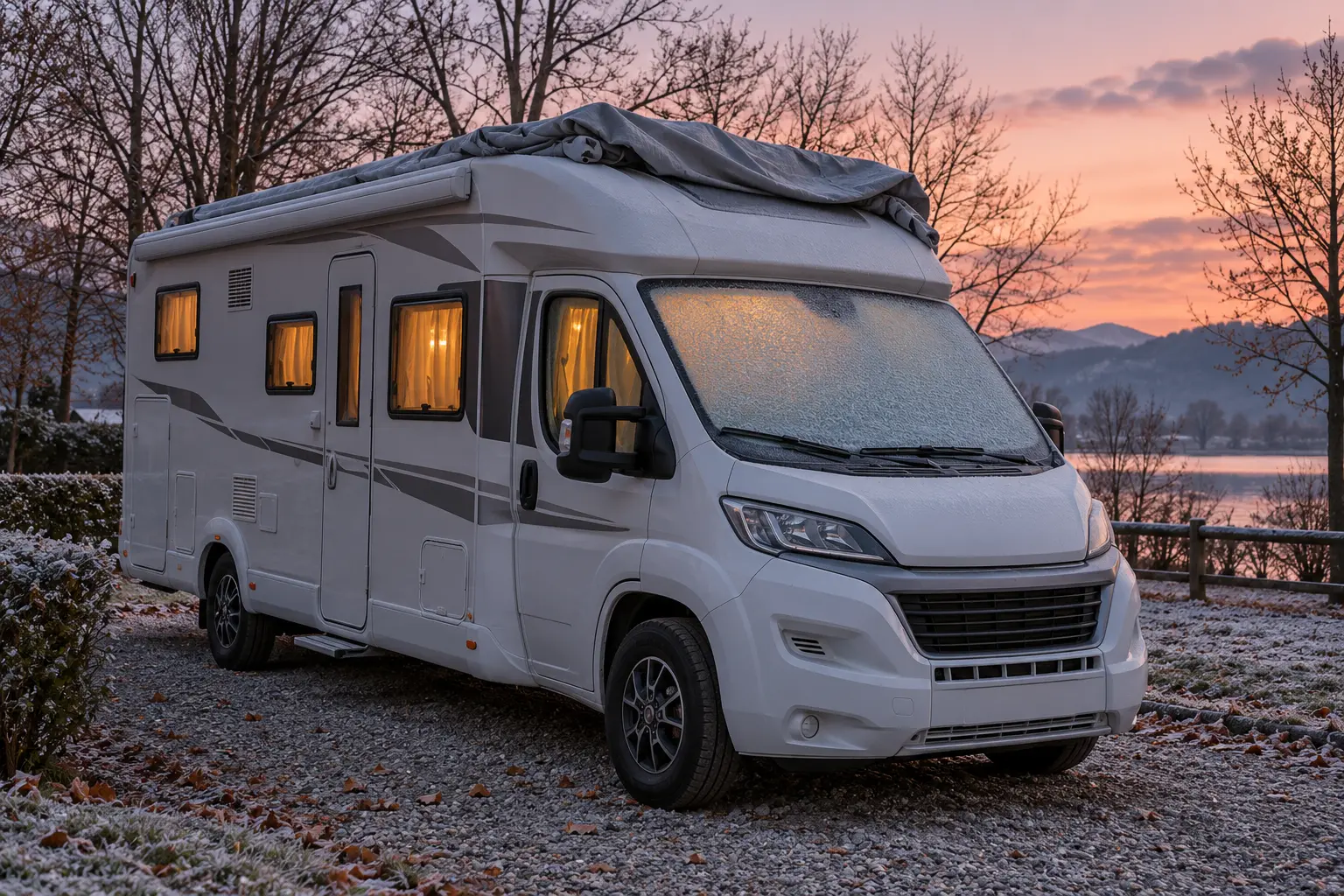
In winter, a motorhome can do one of two things: sit dry in a barn after a careful winterisation, or keep rolling towards mild or snowy destinations. Either way, the enemies are the same: frost in the pipes, damp settling in, flat batteries and flattened tyres. Here is the winterising checklist, followed by the options for sleeping in a motorhome in winter, with the campsites in our selection that have a service area.
Winterising is the right call if you are not going away between November and March, or if your vehicle is not built for the cold (unprotected water lines, weak heating, no double floor). Travelling in winter is possible if the heating, water and electricity keep up. An honest starting point: a motorhome bought for summer holidays is not a winter vehicle. Check your manufacturer’s manual, which overrides any general advice, including the advice on this page.
If you are unsure, start from a simple criterion: how many nights below zero do you expect? A three-day break on the Mediterranean coast does not call for the same precautions as a week in the Cerdagne. For equipping the vehicle for winter travel (heating, propane, carbon monoxide), we refer you to our guide Camping in winter and to our article on winter camping (caravaneige), which already cover these points in detail.
These steps are the usual advice from motorhome owners and dealers. Only the part on the water heater relies on a manufacturer page we have consulted (see below); for everything else, the reference remains your vehicle’s service book and manual.
Freezing water expands and can crack a pump, a tap, a hose or the body of a water heater. The principle is therefore to leave no pocket of water in the system.
For the water heater, Truma, a manufacturer of heaters and water heaters, describes the procedure for its appliances: place a container of at least 10 litres under the drain outlet, switch off the pump, switch off or disconnect the external water supply, open all the water outlets, then flip the yellow drain handle. The manufacturer specifies letting the water heater cool down completely before draining it. For the AquaGo model, you also need to open the yellow drain lever, remove the filter and store it for the winter without putting it back. These instructions appear on the brand’s US help page, in English; check in your manual that your model is covered.
Do you need to drain the water heater? Yes, as soon as the vehicle is exposed to frost without heating: it is the part that holds the most water and the most expensive to replace. If your installation has a bypass valve, the manual explains how to use it.
This is the most common cause of unpleasant surprises in spring: mould on the bedding, smells, tired seals. Remove from the vehicle everything that dislikes damp (linen, food, cushions), leave the fridge open and defrosted, leave the cupboards slightly ajar and lift the mattresses so that air can circulate. A moisture absorber in the living area helps get through the winter, but it does not replace ventilation. Air the vehicle from time to time in dry weather rather than leaving it shut for six months.
The storage location matters almost as much as the preparation. For winter storage of a motorhome, three options exist, with different levels of protection. A converted van or a mid-sized motorhome finds a place indoors more easily than the large coachbuilt models:
| Option | Advantage | Point to watch |
|---|---|---|
| Closed barn or garage | Indoor space sheltered from rain, direct frost and sun; supervision possible, higher price | Check the floor (concrete slab or beaten earth), the ventilation and the access to electricity |
| Storage with a professional or in a farmer’s barn | Often the cheapest; indoors or under cover depending on the offer | Ask whether the site is enclosed, whether there is video surveillance and who holds the keys |
| Outdoor parking | Free at home, available immediately, on a hard surface rather than soft ground | Breathable cover essential, higher risk of theft and damp |
The price of winter storage varies a great deal with the region, the type of storage (indoor or outdoor) and the length of the vehicle: we have not found an official price list, and we prefer not to put forward a figure. Ask for several quotes and compare what is included (electricity, supervision, access to the vehicle during the winter).
Before leaving your vehicle with someone, reread your insurance contract: theft and damage cover is sometimes suspended or limited when the vehicle is stored away from your home, or requires a closed building. Put the question to your insurer in writing and keep the answer.
If you are driving, the regulations apply to you (this is the French rule). According to service-public.gouv.fr, from 1 November to 31 March, vehicles with four or more wheels, motorhomes included, must be equipped in the mountain areas concerned with either removable anti-skid devices (chains or snow socks) for at least two driven wheels, or four tyres suited to winter driving. The obligation covers 34 départements in the Alps, Massif Central, Jura, Pyrenees and Vosges massifs, with lists of communes set by prefectoral order. The official page we consulted covers the 2025-2026 season: recheck the dates for the current winter.
As for self-sufficiency, what matters is electricity (a fan heater consumes a lot), the propane reserve and water protected from frost. For the details, reread our guide on winter camping. There you will find the checked mountain campsites and the list of questions to ask before booking.
Two types of welcome coexist: the campsite, with its pitches and sanitary blocks, and the service area or motorhome aire, which offers waste disposal, water and sometimes electricity without the facilities of a campsite. In winter, the difference matters, because many campsites close their sanitary blocks and pitches while leaving the aire accessible. This is a detail that only the managers can specify: call them.
Of the 511 campsites we have checked, 221 are confirmed open off-season. Among them, 33 pages mention a service area or a service point for motorhomes. Here are examples where this information is written on the campsite’s page:
| Region | Campsite | What the page says |
|---|---|---|
| Occitanie (Aude) | Camping municipal La Giraille, Castelnaudary | Open all year for motorhomes and mobile homes; service point run by Camping-Car Park (water and waste disposal); tents, vans and caravans closed in winter |
| Occitanie (Pyrénées-Orientales) | Camping International du Roussillon, Salses-le-Château | Motorhome aire with a shower block heated in winter, washing machines, no closing month announced |
| Pays de la Loire (Sarthe) | Camping municipal La Chesnaie, Marigné-Laillé | Aire with 14 places and services all year; its sanitary blocks, however, are open only from 1 May to 30 September |
| Pays de la Loire (Maine-et-Loire) | Camping de La Coudraye | Camping-Car Park aire open all year; pitches from 20 April to 31 October |
| Normandy (Manche) | Camping de Collignon | Motorhome aire open from 1 January to 31 December; campsite from 1 May to 30 September |
| Nouvelle-Aquitaine (Charente-Maritime) | Le Dauphin, Saint-Pierre-d’Oléron | Campsite closed from November to March, motorhome aire open all year |
| Nouvelle-Aquitaine (Gironde) | Camping de Mon Village | Aire open all year for motorhomes and self-contained vans; tents and caravans from 1 April to 31 October |
The same campsite can therefore offer, depending on the weeks, a full welcome or a simple parking spot with services. At La Chesnaie, for example, you need to arrive in winter with a vehicle that is self-sufficient for sanitary facilities. Another case, in Rennes: the Camping des Gayeulles is open all year except from 25 December to 1 January, but its sanitary blocks close as early as 2 November; the page specifies that a winter stay is possible in a motorhome or caravan that is self-sufficient for sanitary facilities.
If you are after snow, two campsites in our selection confirm both heated sanitary blocks and a service for motorhomes. The Rioumajou, in Bourisp (Hautes-Pyrénées), announces a Euro-Relais service point, no closure announced, and skiing at Saint-Lary 2 km away. The Domaine de Longemer, in Xonrupt-Longemer (the Vosges), keeps its pitches, its motorhome aire and its wellness area open all year, with downhill and cross-country skiing at Xonrupt-Le Poli. For a partial closure, Les Myrtilles (Haute-Garonne) close from 15 November to 15 December; they then offer a service area and the Luchon spa treatments nearby. Find all our mountain campsites on the mountain page.
For those who want to travel without facing snow, the most frequent answer on our pages is the coast: Oléron (Le Dauphin), the Vendée coast (La Grisse and Le Domaine des Pins announce a service area; the latter keeps its rentals and its aire open all year) or the Roussillon. This choice spares you the chains, but not the damp cold: efficient heating and good ventilation remain useful. Browse the open campsites by region on our pages Occitanie, Pays de la Loire and Nouvelle-Aquitaine, or the sea page.
To understand why so many campsites close in winter and how to spot those that stay open, read our article Why campsites close in winter. And if you prefer to travel off-season without limiting yourself to a motorhome, our article off-season camping, from October to March compares the periods.
On our pages, an aire mentioned on a campsite’s page flags this service, but not its winter hours: always confirm before setting off. A campsite marked “checked” is confirmed open off-season, but that does not guarantee that all the facilities are running.