

guide
No, most campsites are not open in winter, even when their web page claims otherwise. Of the 511 campsites we examined because they said they were open all year, only 221 have off-season opening confirmed by a source. The other 290 are seasonal or impossible to confirm. Here is why campsites close, what our checks showed, and how to recognise the ones that really welcome holidaymakers from November to March.
A campsite that closes is not giving up: it is a business doing the maths. Several reasons add up, and understanding them helps you spot the ones that escape the pattern.
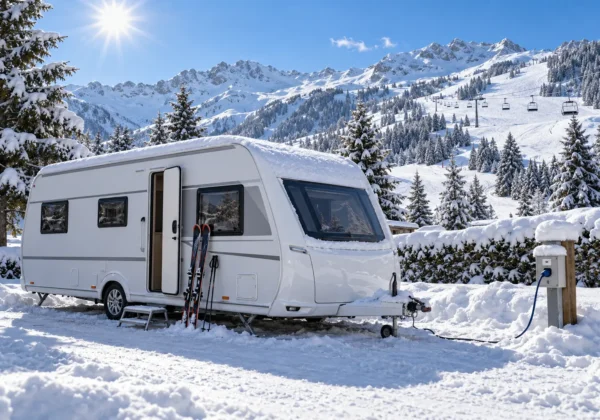
That does not mean no campsite stays open. Those that manage it generally have a solid economic reason: a ski resort nearby, thermal baths, a clientele of spa guests, travelling workers or motorhome owners, or heated permanent accommodation that is rented out all year.
For each campsite in our selection, we noted the opening dates on the official website and in supplementary sources, then classified the campsite according to what those sources actually confirm. The result is clear-cut: the label “open all year” is not enough.
| Status after checking | Campsites | Share | What it means |
|---|---|---|---|
| Off-season opening confirmed | 221 | 43 % | Winter opening confirmed by a source |
| Seasonal | 71 | 14 % | Closure of several months found |
| Unconfirmed | 219 | 43 % | Opening announced but impossible to confirm |
In other words, one campsite in seven advertised as open turns out to be closed for several months, and for more than four in ten we found no evidence of winter opening at all. “Unconfirmed” does not mean “closed”: it means the promise is not proven, and you need to call before booking.
Even among the confirmed campsites, “open in winter” covers very different realities. We classified them according to their announced closure.
| Type of closure | Campsites | Share |
|---|---|---|
| No closure announced | 139 | 63 % |
| Rentals open, pitches closed for part of the winter | 48 | 22 % |
| Short closure between seasons | 34 | 15 % |
And what about comfort? Of these 221 campsites, 49 confirm heated washrooms and 64 confirm heated accommodation. For the others, the information is simply not published: that does not mean it is not heated, but it is up to you to ask.
In the pages we classified as unconfirmed or seasonal, the same traps keep coming up. We illustrate them with real cases, without naming the campsites concerned.
This is the most common trap. About twenty pages in our selection mention residents or mobile home owners: 15 among the unconfirmed campsites, 5 among the seasonal ones. A few cases we found:
The rule is simple: a pitch occupied by its owner does not make a campsite open to holidaymakers. In France, leisure mobile homes may only be installed in specific places (residential leisure parks, classified holiday villages, properly established campsites), as article R111-42 of the Code de l’urbanisme and the Service-public page on parking caravans and mobile homes point out. Many campsites that are open “all year” are therefore open first of all for those who have installed their mobile home there. To understand what these rules allow for anyone who wants to live there, see our article on living all year in a campsite or mobile home.
Directories and old review pages copy dates that are no longer valid. Three cases we found:
Closures change every year: weather, building work, snow cover, school holidays. A date published two years ago is worthless for your stay.
A campsite can accept arrivals without anyone being there to welcome you. On 25 unconfirmed pages, the opening dates are simply not published. On others, only some services run in winter: at the Domaine de Longemer, for example, the restaurant and the grocery shop operate mainly during school holidays. The campsite is open, but not everything that makes it comfortable.
No website replaces a phone call. Here are the three questions that are enough to settle it, to be asked before you send any deposit.
Complete this with three habits: read the terms of sale (the dates are often stated more precisely there than on the home page), check reviews dated from the previous winter, and look at the tourist office page, as in the case of Las Closas. If you are travelling with a caravan, a motorhome or a van, our guide to winter camping, or caravaneige details the equipment; for the whole stay, see camping in winter, the practical guide.
The 221 confirmed campsites are distributed as follows, alongside the total number of campsites each region has in our selection:
| Region | Confirmed in winter | Campsites in the region |
|---|---|---|
| Occitanie | 48 | 109 |
| Auvergne-Rhône-Alpes | 48 | 91 |
| Pays de la Loire | 24 | 39 |
| Nouvelle-Aquitaine | 22 | 55 |
| Provence-Alpes-Côte d’Azur | 17 | 34 |
| Bourgogne-Franche-Comté | 15 | 36 |
| Île-de-France | 9 | 20 |
| Hauts-de-France | 9 | 28 |
| Brittany | 8 | 17 |
| Grand Est | 7 | 27 |
| Centre-Val de Loire | 6 | 28 |
| Normandy | 5 | 19 |
| Corsica | 3 | 8 |
Two lessons. First, the mountain regions (the Alps, the Pyrenees) and the major tourist areas concentrate the supply, with 57 confirmed campsites in the mountains against 19 by the sea: in winter, the coast is the big loser. Second, the countryside carries a lot of weight, with 131 confirmed campsites: farms, estates and municipal campsites, often with chalets or mobile homes rented all year.
By département, Haute-Savoie comes first with 12 confirmed campsites, ahead of the Pyrénées-Orientales and the Vendée (10 each). To widen the search to the shoulder seasons, from autumn to spring, see our article on off-season camping from October to March.