
guide
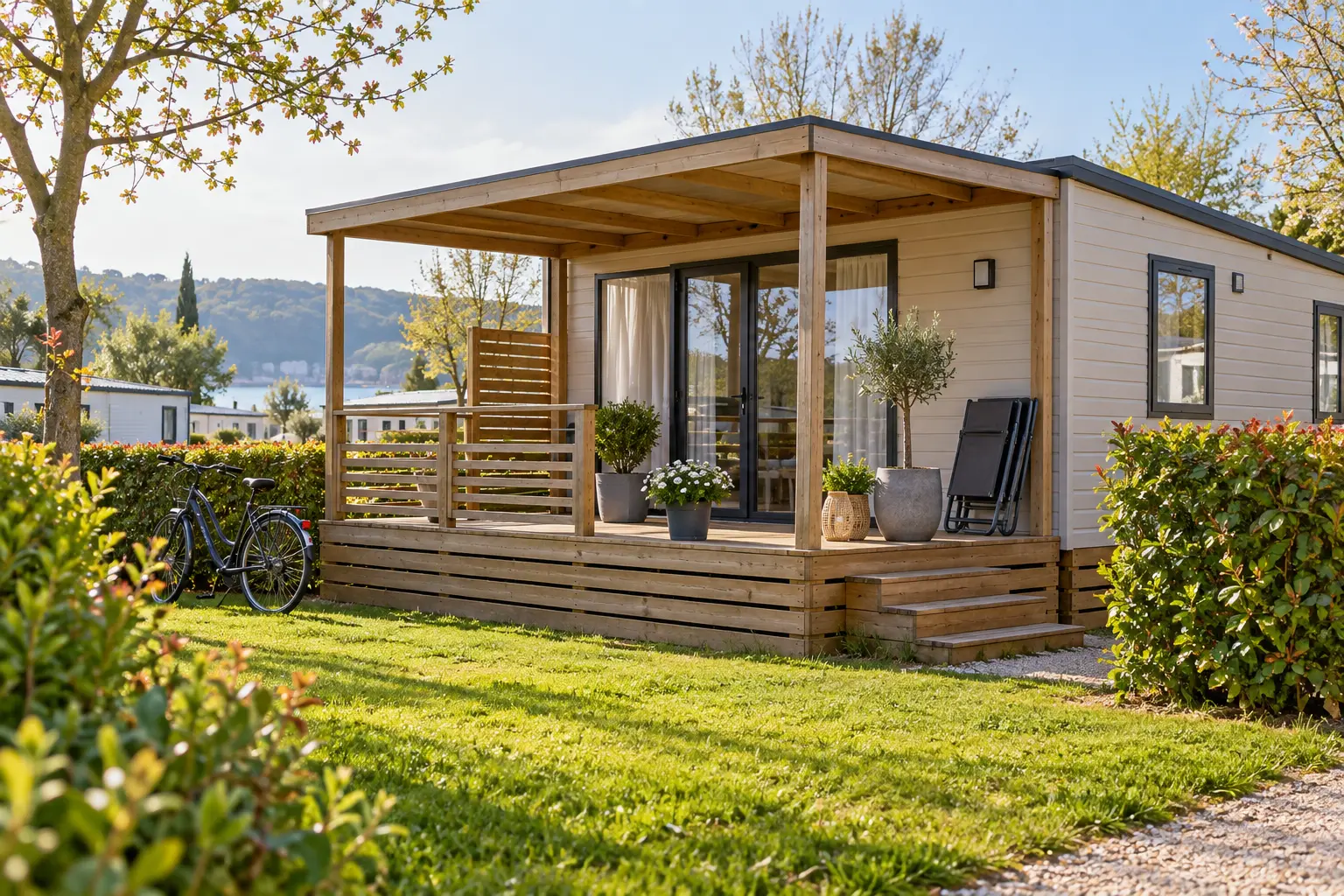
The short answer: the texts we consulted present the mobile home as a holiday residence, not as permanent housing. Living year-round in a campsite is therefore not a right you can invoke and, in the planning law we reread, not a ban written in so many words in the official pages we opened either. In practice, three parties decide: the Code de l’urbanisme (French planning law), the municipality (town hall, local urban plan, in French the plan local d’urbanisme or PLU) and the campsite manager, who sets the contract and the house rules. This article sorts out the regulations: what the law says, what campsites in our selection actually offer, and what to ask before committing.
A warning first: this text is general information, not legal advice. Every rule in this article is French law, so it applies only in France. We only cite rules we reread on Légifrance or on service-public.gouv.fr, with their article number. For your personal situation, the town hall and the campsite manager remain the ones who decide.
The starting point is article R111-41 of the Code de l’urbanisme. It defines “résidences mobiles de loisirs” (mobile leisure residences) as habitable land vehicles “intended for temporary or seasonal occupation for leisure purposes”, which keep means of mobility allowing them to be moved by towing, but which the road traffic code (code de la route) forbids from being driven on the road. That is exactly the definition of a mobile home.
Article R111-42 then says where it can be installed. Only three cases:
Article R111-43 allows awnings, access ramps and removable terraces to be attached to a mobile home inside these places. And article R111-44 sets a limit that many discover late: a mobile leisure residence cannot be installed on a pitch that has been sold outright or rented for a period of more than two years. The text provides exceptions for situations that predate 1 October 2011. A very long-term pitch contract therefore deserves a close read.
The table below places mobile residences alongside the other notions you come across in listings.
| Type of dwelling | What the text says | Article |
|---|---|---|
| Mobile home (résidence mobile de loisirs) | Temporary or seasonal leisure occupation; not driven on the road but keeps its means of mobility | R111-41 |
| Demountable chalet (habitation légère de loisirs) | Demountable or transportable construction, temporary or seasonal leisure occupation | R111-37 |
| Caravan | Habitable vehicle that keeps its means of mobility and that the road traffic code does not forbid from being driven on the road | R111-47 |
| Demountable dwelling constituting permanent housing (résidence démontable constituant l’habitat permanent) | Installation without foundations, occupied as a main residence at least eight months a year, easily and quickly demountable | R111-51 |
The last row is the one most often confused with the mobile home. A “résidence démontable” within the meaning of article R111-51 is a separate category, designed for permanent housing. A campsite mobile home does not belong to it: the texts we read give it a leisure purpose. We did not open the siting rules specific to demountable dwellings, so we do not detail them.
Many listings praise a mobile home on “buildable” land or in a garden. Buildable or not, the guide refers in every case to the local urban plan (PLU). The service-public.gouv.fr guide on parking caravans and mobile homes is clear on this point. A mobile home that keeps its means of mobility (wheels, towbar) cannot stand on private land: it is reserved for campsites, holiday villages and leisure residential parks. If it is stripped of its means of mobility, it is treated as a construction: a prior declaration (déclaration préalable) up to 20 m², a building permit (permis de construire) above that, depending on the surface area, after checking the municipality’s local urban plan.
For a caravan, the rule is different. For less than three months a year (all periods added together), no authorisation is required. Beyond that, a prior declaration at the town hall is mandatory, under article R*421-23 d) of the Code de l’urbanisme. Article R111-48 also forbids installing a caravan in areas where camping is prohibited, as well as in woods, forests and parks classified by the local urban plan as woodland to be preserved.
Practical conclusion: buying a second-hand mobile home to “put it on a plot of land” is the classic trap. Before any purchase, call the town hall’s planning department, give the address of the plot and ask what the local urban plan allows there.
Three questions come up constantly: can you register your address at a campsite, receive your mail there, declare the mobile home as your main residence? We found no official page that answers a direct “yes” or “no” for a campsite, and we refuse to invent one. Here are the verifiable points.
There are two situations to tell apart. In the first, you rent accommodation that belongs to the campsite (mobile home, chalet), by the month or for a long period. In the second, you install your own mobile home on a rented pitch: that is where the limit of article R111-44 and the campsite’s pitch contract apply.
Of the 511 campsites we verified, 221 are confirmed as open outside the season. Among them, 11 advertise on their website rental by the month or year, or a long stay. That is few, which means the information is something you ask for rather than read. A few examples from our selection, with what each one states:
| Campsite | What the campsite advertises |
|---|---|
| La Venise du Bocage (Nesmy, Vendée) | Rental units open from June to April, monthly rental for students and workers from September to April |
| Les Chalets de Gaillac (Gaillac, Tarn) | Chalets and mobile home open all year, by the night, the week or the month (monthly rentals from September to May) |
| Les Chalets de l’Heronniere (Chef-Boutonne, Deux-Sèvres) | Estate open all year for monthly rentals; from December to March, no weekends and no weeks |
| Camping municipal de La Raza (Meillonnas, Ain) | Pitches from 15 April to 15 October; accommodation rented by the month from 15 October to 15 April |
| Le Fromentel (Gommegnies, Nord) | Open all year; mobile homes to rent by the week, the month or the year |
| Camping municipal Les Mielles (Surtainville, Manche) | Open all year; stays by the day, the week, the month or the year |
| La Vallée des Tamaris (Courpalay, Seine-et-Marne) | Mobile homes and chalets to rent for a minimum of one month, pitches for passing guests |
These statements come from the campsites themselves. They do not replace a quote or a contract: dates and minimum stays change from one season to the next.
Monthly rental is used mainly in winter by people who do not need a permanent “home”: a building job of a few months, a seasonal contract, an internship, a year of study. At La Venise du Bocage, the monthly option explicitly targets students and workers. L’Île du Roi, in Triel-sur-Seine in the Yvelines, advertises a campsite open all year “for tourist and professional stays”, with plots by the month and a coworking space. The Parc résidentiel Le Refuge, in Seine-et-Marne, describes a shared atmosphere between residents, holidaymakers and workers.
For this kind of stay, check above all the heating and insulation of the accommodation. Of our 221 verified campsites, 64 confirm heated accommodation and 49 heated sanitary blocks; for the others, the information is simply not published. Our article on winter camping goes into these points, and the one on campsites that are really open in winter explains how to check the advertised dates. You can also browse campsites with mobile homes or chalets and take a closer look at the campsites in the Vendée or those in Île-de-France.
We do not give a price range. No official source sets a rate, and the campsite pages we reread do not publish a comparable monthly price. What can be said: the price depends on the region, the type of accommodation, the period and the charges. Always ask for a detailed quote that specifies:
A few questions, put in writing to the manager and to the town hall, avoid most unpleasant surprises:
A “year-round campsite”, in the everyday sense, is therefore simply a site open twelve months out of twelve. Leisure residential parks, on the other hand, are a category cited by article R111-42, with their own operating rules.